Blog
How to Choose a Wood Chest of Drawers for Your Home

A wood chest of drawers can bring useful storage to a bedroom, living room or guest space. Choosing one starts with a simple question: what needs a home, and where will you use it?
The number of drawers is only part of the decision. Their usable space, the cabinet’s proportions and the room needed to open them all affect how well the piece works in everyday life.
Decide What the Drawers Need to Hold
Before comparing designs, make a short list of the belongings you want to store. Folded clothing, small accessories, paperwork and spare household items each need a different arrangement.
A chest with several drawers can help separate categories. However, five drawers do not automatically provide more usable storage than a different cabinet with fewer, deeper drawers.
Compare Usable Space, Not Just Drawer Count
Check internal drawer measurements when available. The cabinet’s external width and depth do not tell you exactly what will fit inside.
If you plan to use organizers, compare their dimensions with the drawer interior and allow enough room for the drawer to close freely. For folded clothing, measure a typical folded item before deciding how many stacks a drawer could accommodate.
Keep the items you reach for most often in a comfortable position. A useful storage arrangement should make it easy to find and return things without unpacking the whole drawer.
Measure the Cabinet in Use
Measure the proposed location with the surrounding furniture in place. Include skirting boards, sockets, door swings and anything else that may affect placement.
Mark the cabinet’s footprint on the floor with removable tape suitable for the surface. Then consider the space in front of it.
A chest may fit neatly against a wall while still making the room awkward when a drawer is open. Check that you can stand comfortably in front of it without blocking a doorway or pressing against nearby furniture.
Compare Tall and Wide Layouts
A taller chest can be worth considering when wall width is limited. A lower, wider dresser may suit a longer wall or a room where a broader top surface is useful.
Neither shape is automatically better. Compare actual dimensions, drawer capacity and how comfortably you can reach the upper drawers. A narrow silhouette alone does not prove that a piece will suit a small room.
Look Closely at Materials and Finish
“Wood” can describe different furniture constructions. Read the product information for the stated materials and any distinctions between the frame, drawer sides, drawer bottoms and other components.
Colour names also need care. A walnut-coloured finish does not necessarily mean the furniture is made from walnut wood.
Photographs help you assess the overall appearance, but they cannot confirm every construction detail. Ask for clarification when a material or finish matters to your purchase, and expect some variation in how colours appear on different screens.
Coordinate Wood Tones with the Room
Start with the largest surfaces around the chest: flooring, walls, a bed or a sofa. Decide whether the cabinet should blend into that palette or introduce a warmer contrast.
You do not need an exact match between every wooden piece. Repeating a related tone or a small detail can help the room feel connected. For example, understated metal handles can relate to another finish already present in the space.
Keep the top useful as well as decorative. A small tray may be enough for loose everyday items, while leaving part of the surface clear gives you somewhere to set things down.
Consider a Five-Drawer Cherry Wood Design
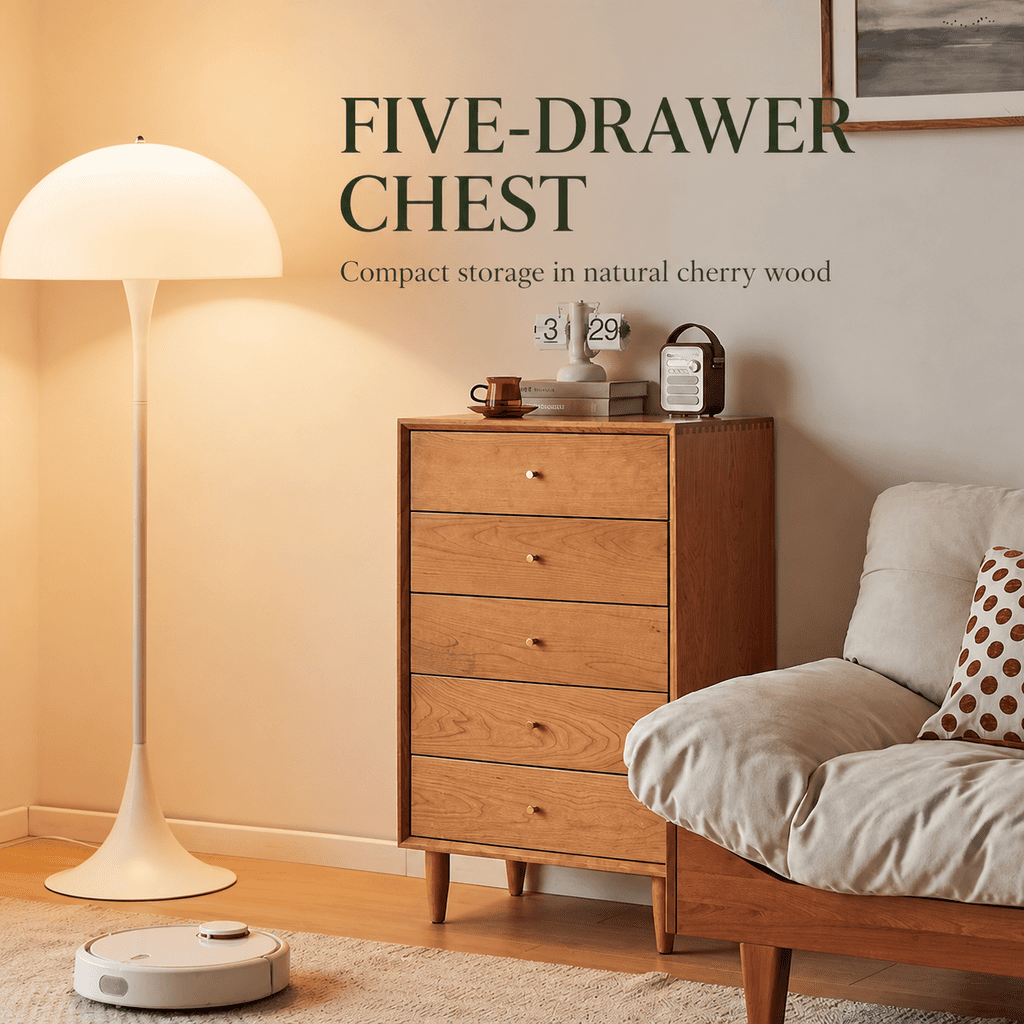
The Natural Cherry Wood Five-Drawer Chest offers one option for this approach. Its five drawers, natural cherry wood appearance, brass pulls and tapered legs combine enclosed storage with a warm, understated look.
Consider it alongside the items you need to store and the space available in your room. Check the current product details for dimensions, delivery information and assembly requirements before ordering.
The surrounding furniture and decorative objects in styled images are for inspiration and are not part of the chest.
Check Installation, Delivery and Care Details
Confirm packaged dimensions and the delivery route before purchase, particularly where stairs, narrow turns or lifts are involved. Do not assume that legs or other components are removable unless this is confirmed.
Follow the supplied installation and anti-tip instructions, and confirm suitable wall-fixing arrangements for the furniture and your wall. Do not allow children to climb on drawers.
For everyday care, use the instructions supplied with the specific finish. Our Furniture Care & Assembly Guide provides general guidance to read alongside those product instructions.
Make a Final Comparison
Before choosing your chest, check these points together:
- The belongings you want each drawer to hold.
- External dimensions and available internal drawer measurements.
- Space for opening drawers and moving around the room.
- Confirmed materials, finish and included components.
- Delivery access, assembly and installation requirements.
Use the Lomera Living storage collection to compare different layouts. Choose the arrangement that fits your belongings and the way you use the room, then refine the colour and styling details.
Frequently Asked Questions
Is a five-drawer chest suitable for a small bedroom?
It can be, depending on its dimensions and the room layout. Check both the closed footprint and the space needed to open drawers and stand in front of them.
Does a wood chest need to match my other furniture?
An exact match is not necessary. Related wood tones, proportions or hardware finishes can help different pieces work together.
Can a chest of drawers be used in a living room?
Yes, provided its dimensions and intended use suit the space. Consider what you want to store and whether enclosed drawers would be more useful than open shelving.